By Hannah Jarosch
Molly Pickering decided to try and quit her social media habits after realizing it was a drain on her life.
Pickering said she used to consider herself addicted to social media. She would struggle to keep up with her studies and would face challenges with her mental health.
It was a challenge for Pickering to switch up her social media habits because she felt she would be left out of the loop with her friendships and events happening in society.
“Everyone else has it, so I feel like I need it too,” Pickering said. “I feel like there’s always something new and I have the pressure to always keep on top of new things.”
Pickering is one of many students who excessively engage with some form of social media. Some students even consider themselves addicted to social media.
More than 40% of social media users said they would give up their television, car, or pet before they disabled their social media pages, according to a survey from the Reboot Foundation.
Students like Pickering can face other problems from excessive social media use, such as low self-esteem, anxiety, stress, lack of sleep, body dysmorphia, depression, and others, according to Psychiatric Times.
Frequent social media use among teens has been linked to poor academic performance and other potential negative consequences, according to the Digital Wellness Lab at Boston Children’s Hospital Center for Media and Child Health.
University of Minnesota student, Lauren Godfrey, said she would miss assignments because of social media which impacted her grades.
“I would spend hours scrolling on TikTok instead of doing my homework,” Godfrey said. “It takes me a lot of self-control to say, okay, it’s time to put my phone down.”
The blue light emitted by your cell phone screen restrains the production of melatonin, the hormone that controls your sleep-wake cycle, according to SCL Health. This makes it even more difficult to fall asleep and wake up the next day.
University of Minnesota student, Rose Prosser, said she gets five to six hours of sleep a night if she is lucky.
“It’s just so addicting to the point where I would rather keep watching videos than go to sleep,” Prosser said.
Nurse Practitioner, Chris Feder, said students should be receiving eight to 10 hours of sleep a night. A regular sleep schedule is extremely important, especially for students because they need that time to recharge and consolidate what they have learned that day during REM sleep.
REM sleep is important for memory and emotional processing as well as healthy brain development, according to sleepfoundation.org. Students who do not receive enough sleep can lead to poor academic performance because focus, concentration, and memory processing are significantly altered.
“Lack of sleep can lead to other health risks like obesity, diabetes, stroke, high blood pressure, and so many others,” Feder said. “Do yourself a favor and get a good night’s sleep.”
From the 10 students interviewed, their weekly average number of hours spent on certain social media platforms was much higher than what Datareportal.com generated.
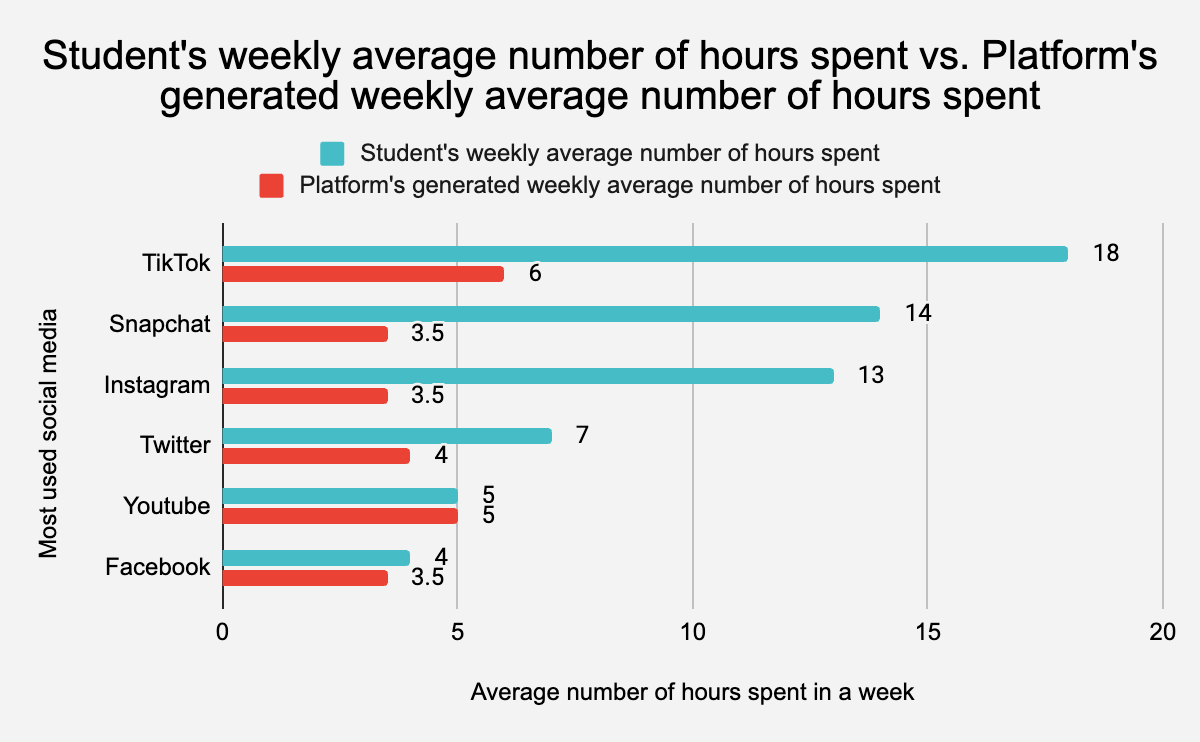
Data from the 10 students interviewed and Datareportal.com.
University of Minnesota student, Abby Hansen, said she often finds herself comparing herself to others she sees on social media.
“I see all these skinny girls and it makes me jealous and then it makes me feel bad about myself,” Hansen said. “I could be in a really good mood and then instantly it would just kill it.”
University of Minnesota staff psychologist, Ian Evans, said social media is a common topic when discussing a student’s mental health. Social comparison and the classic FOMO, fear of missing out, are the big topics he hears with his students.
“Social media outlets can increase isolation rather than increase connections,” Evans said. “I see lower motivation and decreased self-worth in students who compare themselves to other students.”
Most students interviewed said they often get moments of anxiety when engaging with social media, especially on Facebook and Twitter. University of Minnesota student, Jacob Hanson, said there is a lot of controversy on these platforms that he doesn’t know what to believe.
“I often get offended and feel many emotions of frustration, stress, and anxiety when people comment every single opinion they have on Facebook,” Hanson said.
University of Minnesota student, Justin Erickson, said he doesn’t believe everything he sees on social media.
“You just gotta take everything with a grain of salt and know that everyone is posting the best parts of their life on social media,” Erickson said.
Since Pickering took a step back from social media, she noticed she had more time in the day than she thought.
“I realized I have more time to plan out my studies and my grades have definitely gone up,” Pickering said. “Not even my grades, but the performance and effort I’m putting into school.”
Pickering said she found herself exercising more and even used her apartment’s gym for the first time.
“I’ve enjoyed being able to get active and reconnect with that side of me,” Pickering said.
Students typically do not recognize social media addiction the same way they would recognize drug or alcohol addictions, according to Evans.
Board Certified Psychiatrist specializing in addiction, James Van Doren, said while there is no specific cause of addiction, trauma, mental health struggles, and genetics have strong correlations with addiction, specifically, substance abuse.
“Addiction can affect anyone, but it’s important to understand that anyone is worth recovery, ” Doren said.
The University of Minnesota provides services such as consultations and assessments, and therapy services through Boynton Health. However, these services are specific for alcohol and substance abuse.
There are currently no services catered specifically for social media addiction through the university despite how widespread it affects its students. However, the university provides tips and services for mental health, according to the University Office of Human Resources.
Mental health care is covered by the University’s Medical Program where students can ask for help finding a mental health provider, according to the University Office of Human Resources. Students can also find resources to help manage stress and enhance their resilience through the Wellbeing Program.
Evans said having awareness and honesty with oneself is key to the process of trying to quit or even limit social media.
“I recommend reconnecting with the things you value,” Evans said. “Whether that’s a little bit of physical activity, eating a little bit better, and also giving yourself a little bit of compassion along the way because we are not going to be perfect in that process.”
 Hannah Jarosch